AI research · Self-supervised learning · World models

Marcin Przewięźlikowski

Learning to understand and predict the world without labels.

AI researcher at GMUM, Jagiellonian University · Kraków, Poland

Portrait of Marcin Przewięźlikowski

01

Research

My research is about learning representations of the visual world without human labels. I study what self-supervised models actually learn, how to make their representations more useful and spatially aware, and how to adapt them to new tasks with little data. The long-term goal is world models that understand their surroundings well enough to predict how they change.

I’ve also spent four years as an ML engineer, shipping production computer vision for retail. I’ve submitted my PhD thesis at the Jagiellonian University and will defend it in December 2026.

  • Self-supervised learning

    Learning visual representations without labels, and understanding what those representations capture.

    Beyond [CLS]CASSLE

  • World models

    Spatially aware representations that capture how the world is structured and how it changes.

    SpaRRTa

  • Data efficiency

    Adapting models to new tasks and domains with as few labels as possible.

    HyperShotSeBA

02

Selected work

Google Scholar
Overview figure for Beyond [CLS]

ICCV 2025

Beyond [CLS]: Exploring the True Potential of Masked Image Modeling Representations

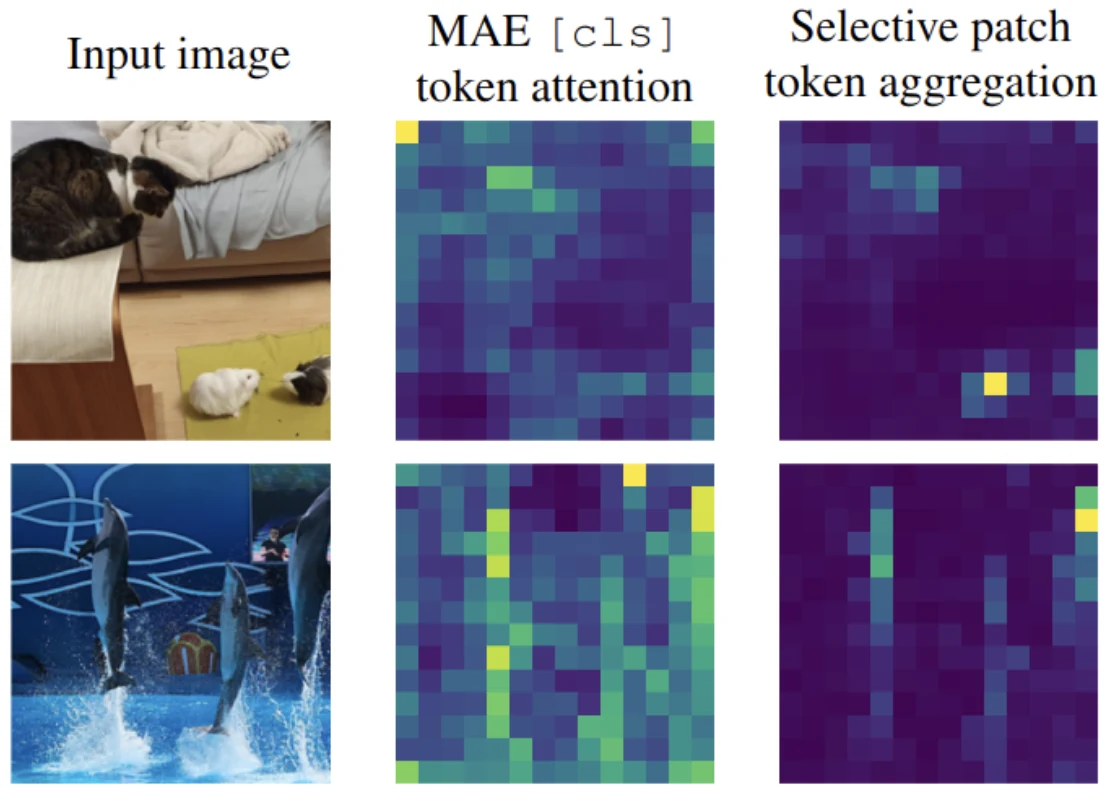
Why do masked image models look weak out of the box? Their attention is spread almost uniformly over patches, so the [CLS] token aggregates them poorly. Selective Aggregation makes better use of the semantic information already present in the patch tokens.

Marcin Przewięźlikowski, Randall Balestriero, Wojciech Jasiński, Marek Śmieja, Bartosz Zieliński

Also presented at the UniReps Workshop at NeurIPS 2025.
Overview figure for SpaRRTa

IJCV 2026

SpaRRTa: A Synthetic Benchmark for Evaluating Spatial Intelligence in Visual Foundation Models

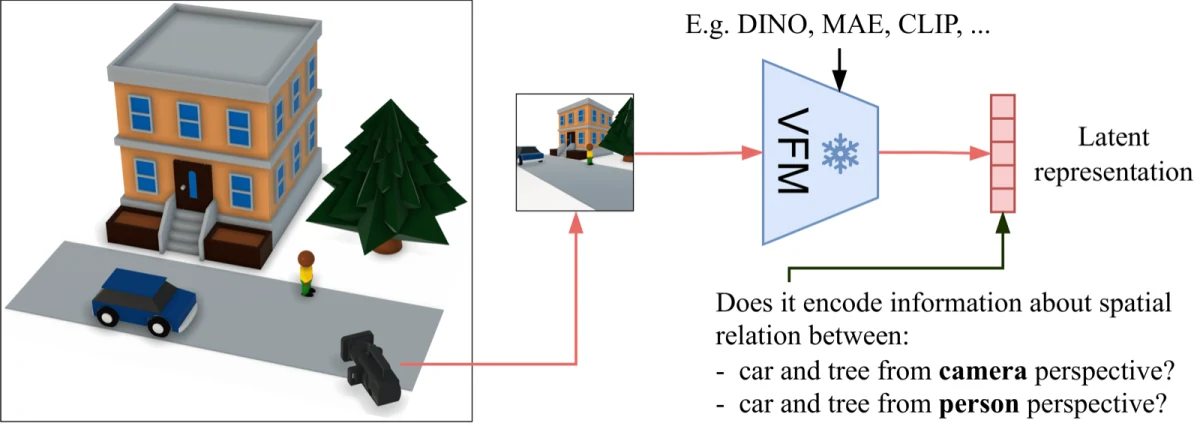
Do frozen visual foundation models know where objects are relative to each other, from the camera's viewpoint and from another observer's? SpaRRTa probes this with photorealistic scenes with controllable object arrangements and free spatial annotations, and finds large differences in spatial awareness across popular models.

Turhan Can Kargin, Wojciech Jasiński, Adam Pardyl, Bartosz Zieliński, Marcin Przewięźlikowski

Also presented at the 2nd Workshop on World Models, ICLR 2026.

Overview figure for CASSLE

KBS 2024

Augmentation-aware Self-supervised Learning with Conditioned Projector

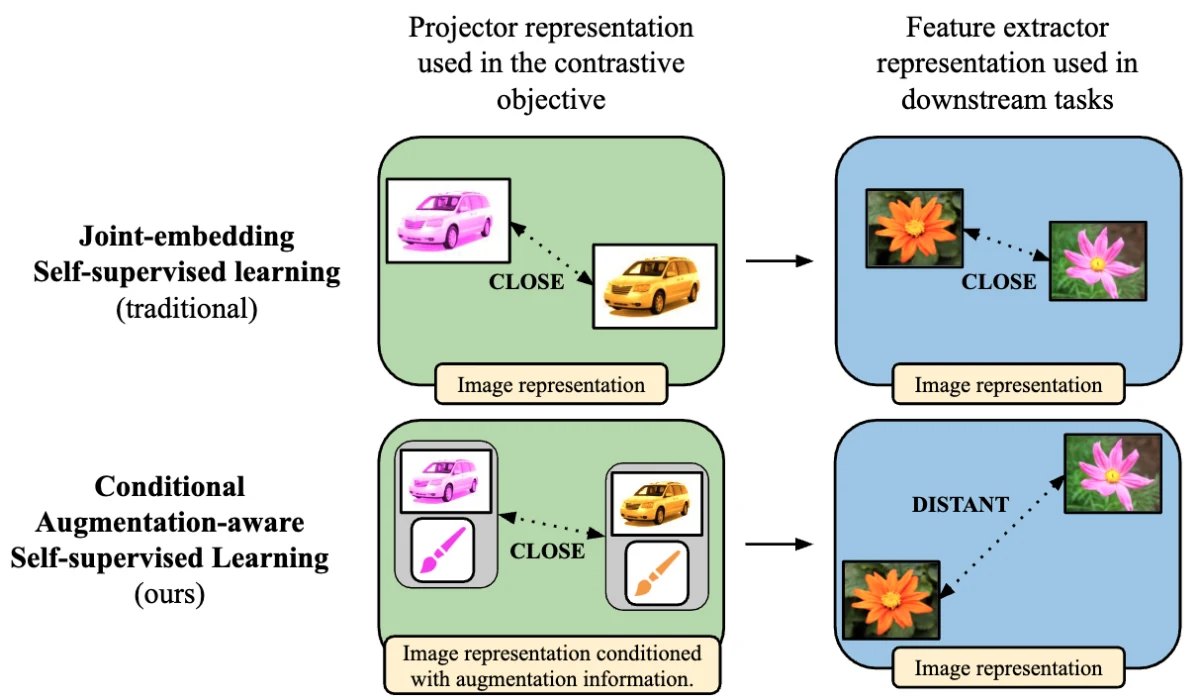
Invariance to augmentations can discard information that downstream tasks need, such as colour. CASSLE conditions the projector on the applied augmentations, so the encoder keeps that information. It works with common joint-embedding SSL methods without architectural changes.

Marcin Przewięźlikowski, Mateusz Pyla, Bartosz Zieliński, Bartłomiej Twardowski, Jacek Tabor, Marek Śmieja

A short version appeared at the NeurIPS 2023 Workshop on Self-Supervised Learning.

Published at ICCV · IJCV · WACV · ECML PKDD · SDM · Knowledge-Based Systems · Neurocomputing

All publications 19

2026

  1. SpaRRTa: A Synthetic Benchmark for Evaluating Spatial Intelligence in Visual Foundation Models

    Turhan Can Kargin, Wojciech Jasiński, Adam Pardyl, Bartosz Zieliński, Marcin Przewięźlikowski

    IJCV 2026 International Journal of Computer Vision

  2. SeBA: Semi-supervised Few-shot Learning via Separated-at-Birth Alignment for Tabular Data

    Kacper Jurek, Wojciech Batko, Marek Śmieja, Marcin Przewięźlikowski

    SDM 2026 SIAM International Conference on Data Mining

  3. WildMatch: Weakly Supervised Image Matcher Adaptation for Wildlife Re-Identification

    Turhan Can Kargin, Piotr Kubaty, Ekaterina Rostovskaya, Izabela Wierzbowska, Bartosz Zieliński, Marcin Przewięźlikowski

    arXiv 2026 Preprint

  4. Adaptive Contrastive Hierarchical Clustering with Nodes Visualization

    Mateusz Pach, Przemysław Rola, Michał Znalezniak, Patryk Kaszuba, Marcin Przewięźlikowski, Jacek Tabor, Marek Śmieja

    AIR 2026 Artificial Intelligence Review

  5. Hypernetwork Approach to Rapid NeRF Adaptation

    Paweł Batorski, Dawid Malarz, Marcin Przewięźlikowski, Marcin Mazur, Sławomir Tadeja, Przemysław Spurek

    KBS 2026 Knowledge-Based Systems

  6. Data-Efficient Representation Learning and Adaptation

    Marcin Przewięźlikowski

    PhD thesis 2026 Jagiellonian University, advised by prof. Marek Śmieja

2025

  1. Beyond [CLS]: Exploring the True Potential of Masked Image Modeling Representations

    Marcin Przewięźlikowski, Randall Balestriero, Wojciech Jasiński, Marek Śmieja, Bartosz Zieliński

    ICCV 2025 IEEE/CVF International Conference on Computer Vision

  2. Hypernetwork Approach to Bayesian MAML (Student Abstract)

    Piotr Borycki, Piotr Kubacki, Marcin Przewięźlikowski, Tomasz Kuśmierczyk, Jacek Tabor, Przemysław Spurek

    AAAI 2025 AAAI Conference on Artificial Intelligence, Student Abstract track

2024

  1. Augmentation-aware Self-supervised Learning with Conditioned Projector

    Marcin Przewięźlikowski, Mateusz Pyla, Bartosz Zieliński, Bartłomiej Twardowski, Jacek Tabor, Marek Śmieja

    KBS 2024 Knowledge-Based Systems

  2. A Deep Cut into Split Federated Self-supervised Learning

    Marcin Przewięźlikowski, Marcin Osial, Bartosz Zieliński, Marek Śmieja

    ECML PKDD 2024 European Conference on Machine Learning and Principles and Practice of Knowledge Discovery in Databases

  3. HyperMAML: Few-shot Adaptation of Deep Models with Hypernetworks

    Marcin Przewięźlikowski*, Przemysław Przybysz*, Jacek Tabor, Maciej Zięba, Przemysław Spurek

    Neurocomputing 2024

  4. RegFlow: Probabilistic Flow-based Regression for Future Prediction

    Maciej Zięba, Marcin Przewięźlikowski, Marek Śmieja, Jacek Tabor, Tomasz Trzciński, Przemysław Spurek

    ACIIDS 2024 Asian Conference on Intelligent Information and Database Systems

  5. Adapt Your Teacher: Improving Knowledge Distillation for Exemplar-free Continual Learning

    Filip Szatkowski, Mateusz Pyla, Marcin Przewięźlikowski, Sebastian Cygert, Bartłomiej Twardowski, Tomasz Trzciński

    WACV 2024 IEEE/CVF Winter Conference on Applications of Computer Vision

2023

  1. Zero Time Waste in Pre-trained Early Exit Neural Networks

    Bartosz Wójcik, Marcin Przewięźlikowski, Filip Szatkowski, Maciej Wołczyk, Klaudia Bałazy, Bartłomiej Krzepkowski, Igor Podolak, Jacek Tabor, Marek Śmieja, Tomasz Trzciński

    Neural Networks 2023

  2. The General Framework for Few-shot Learning by Kernel HyperNetworks

    Marcin Sendera*, Marcin Przewięźlikowski*, Jan Miksa, Mateusz Rajski, Konrad Karanowski, Maciej Zięba, Jacek Tabor, Przemysław Spurek

    MVA 2023 Machine Vision and Applications

  3. HyperShot: Few-Shot Learning by Kernel HyperNetworks

    Marcin Sendera*, Marcin Przewięźlikowski*, Konrad Karanowski, Maciej Zięba, Jacek Tabor, Przemysław Spurek

    WACV 2023 Best Paper Award finalist IEEE/CVF Winter Conference on Applications of Computer Vision

2022

  1. MisConv: Convolutional Neural Networks for Missing Data

    Marcin Przewięźlikowski, Marek Śmieja, Łukasz Struski, Jacek Tabor

    WACV 2022 IEEE/CVF Winter Conference on Applications of Computer Vision

2020

  1. Estimating Conditional Density of Missing Values Using Deep Gaussian Mixture Model

    Marcin Przewięźlikowski, Marek Śmieja, Łukasz Struski

    ICONIP 2020 International Conference on Neural Information Processing

2019

  1. Support for High-Level Quantum Bayesian Inference

    Marcin Przewięźlikowski, Michał Grabowski, Dariusz Kurzyk, Katarzyna Rycerz

    ICCS 2019 International Conference on Computational Science

* Equal contribution.

03

Experience

Research and engineering

  1. Mar 2026 – now

    Research Assistant

    GMUM, Jagiellonian University

    Visual foundation models and world models, and computer vision for identifying individual lynxes in Polish national parks.

  2. 2024 – 2026

    Principal Investigator, NCN PRELUDIUM 22 grant

    Jagiellonian University

    Reducing the biases that pretraining objectives build into self-supervised models, so they transfer better with less labelled data.

  3. 2024 – now

    Research collaboration with dr Randall Balestriero

    Brown University

    Joint research on self-supervised representations, including Beyond [CLS] (ICCV 2025). Visiting researcher and guest lecturer at Brown in 2025.

  4. 2023

    Research internship with prof. Joost van de Weijer and dr Bartłomiej Twardowski

    Computer Vision Center, Barcelona

    Studied which properties make visual encoders useful for continual learning, and worked on CASSLE.

  5. 2022 – 2025

    PhD researcher, Zero-Waste Machine Learning in Computer Vision

    IDEAS NCBR

    Data-efficient and self-supervised learning in prof. Tomasz Trzciński’s group, including federated and video settings.

  6. 2018 – 2022

    Machine Learning Engineer Industry

    ShelfWise (acquired by FORM.com)

    Built and maintained a production object-detection system for retail, used daily by thousands of sales representatives at companies including Anheuser-Busch and Heineken; research on visual search and few-shot classification.

  7. 2017

    Software Developer Intern Industry

    Amazon Development Centre Poland

    Deep learning for text processing and analysis.

Education

  1. 2021 – 2026

    PhD candidate in Computer Science

    Jagiellonian University, advised by prof. Marek Śmieja

    Thesis: Data-Efficient Representation Learning and Adaptation, defence in December 2026.

  2. 2019 – 2021

    MSc in Computer Science (Machine Learning)

    Jagiellonian University

  3. 2015 – 2019

    BEng in Computer Science

    AGH University of Science and Technology

04

News

All news
  1. SpaRRTa, our benchmark for spatial reasoning in visual foundation models, is published in the International Journal of Computer Vision. More: SpaRRTa, our benchmark for spatial reasoning...

  2. The Machine Learning Summer School on Reliability & Safety starts in Kraków. I am part of the programme team. More: The Machine Learning Summer School on...

  3. I received the Polish Minister of Science and Higher Education’s scholarship for outstanding young scientists, awarded to 290 researchers in Poland, including 40 PhD students. More: I received the Polish Minister of...

  4. Our paper Beyond [CLS]: Exploring the True Potential of Masked Image Modeling Representations is accepted to ICCV 2025.

  5. Augmentation-aware Self-supervised Learning with Conditioned Projector is published in Knowledge-Based Systems.

05

Recognition and service

Grants and awards

  1. 2025 – 2028
  2. 2024 – 2026

    Excellence Module award, Jagiellonian University Excellence Initiative

  3. 2023
  4. 2023
  5. 2022 – 2026

    Funded researcher on NCN OPUS and SONATA BIS grants; co-investigator on an NCN PRELUDIUM grant

  6. 2021

    Minister of Education and Science scholarship for outstanding students

    Awarded to the top 16 computer science students in Poland.

Community

  1. 2026
  2. 2025
  3. 2024

    Invited talk on self-supervised learning, 33rd Economic Forum, Karpacz

  4. 2023

    Organiser, Machine Learning Summer School on Applications in Science

Reviewing

NeurIPS, ICLR, CVPR, ECCV, AAAI, AISTATS, BMVC, WACV and ECAI; the International Journal of Computer Vision, Neurocomputing and Scientific Reports; and workshops on world modeling, unifying representations (NeurIPS) and self-supervised learning (NeurIPS).

Teaching

Guest lectures on self-supervised learning at Brown University; courses on machine learning and effective Python programming at the Jagiellonian University; and, as head of the AI section of the BIT Scientific Group at AGH, 20+ introductory machine learning workshops.

06

Get in touch

I’m happy to talk about self-supervised learning, world models, research collaborations and interesting research opportunities. Email is the best way to reach me.